


Futures don’t arrive all at once. They diffuse through society in cascading waves. Three Horizons is a framework for watching these waves, and tracking the little eddies where future currents surge ahead.

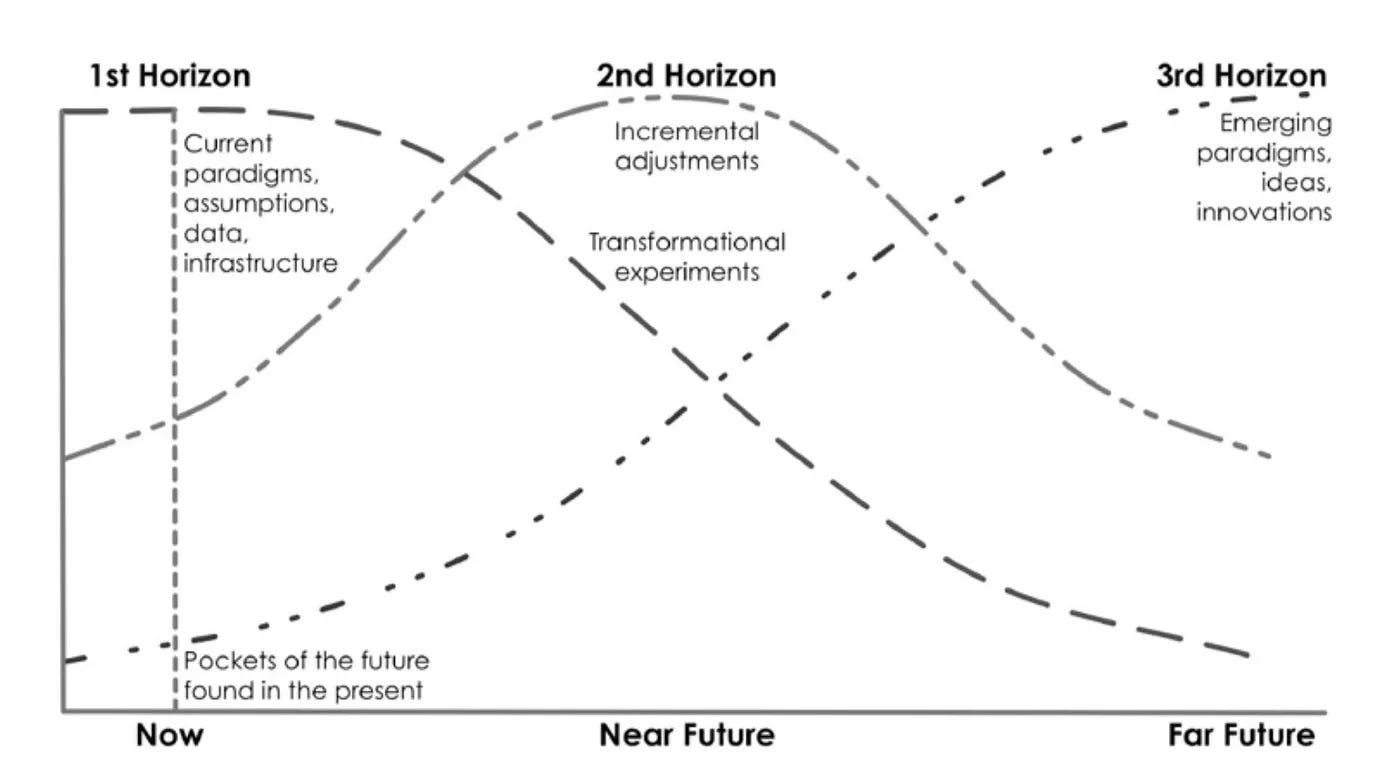
We can think about systemic change as happening across three horizons:
Horizon 1: business as usual. The incumbent system that is coasting on momentum, but is losing fit as conditions change.
Horizon 2: transition zone. The turbulent zone where experiments attempt to bridge H1 and H3. Some of these experiments try to extend H1 using ideas from H3. We call these H2-minus. Others try to shift the world toward the values of H3. We call these H2-plus.
Horizon 3: viable world. The latent new paradigm. It reimagines the system around the logic of new innovation. This paradigm is still incubating, but it can be sensed via weak signals, “pockets of the future” that are present in the present. It grows to become a new viable equilibrium.
All three horizons exist right now, overlapping, at the same time. This means that once we know how to look for them, we can see the three horizons all around us.
Take transportation, for example:
H1: Gas-powered cars that belong to a single household, Suburbs, freeways, office parks, chain restaurants, and big-box stores. The status-quo.
H2: Hybrid cars are a very literal manifestation of the H2 transition zone, but most EVs—sports cars, sedans, and SUVs—belong to H2 as well. Today’s EVs are the same car, but with a different power train. We could call these H2-minus, because they try to sustain the old paradigm while importing elements of the new one. There are also H2-plus experiments happening: e-bikes, scooter shares, and robotaxis are all experiments in imagining how electric batteries and mobile connectivity could refactor transportation.
H3: Transportation-as-a-service. Autonomous fleets of electric microbuses and ubiquitous bike and scooter share. Robotic vans deliver groceries, packages, and takeout from ghost kitchens. Cities begin reclaiming their neighborhood streets, installing cycling lanes, creating parklets and walking paths where cars used to be.
Notice that H3 is not describing an individual technology, so much as a systemic transformation that could happen if we fully embrace the logic of electrification, batteries, and smartphones.
A good science fiction story should be able to predict not the automobile, but the traffic jam.
–Frederik Pohl
Also notice that H3 is a choice. We build our systems with our tools, and around our values. While H1 and H2 carry the legacy of old values, H3 sheds that legacy and seeks to manifest new values. And there will be competing values, and contested visions for what H3 could look like.
Regardless, these transformational shifts tend to happen slowly, then all at once, and there are often signals when you are nearing a tipping point. One good place to look is changes in values and changes in consumption patterns. For example, in transportation, we might track the percentage of teens getting a driver’s license, or households putting off purchase of a second vehicle.
The future is already here – it’s just not evenly distributed.
–William Gibson
All three of these horizons exist today, they’re just not evenly distributed. So, can we spot to examples of H3 around us now?
Barcelona is creating “superblocks” by turning streets into parks and paths for people. Public transit and cars are pushed to the periphery of these quiet neighborhood islands. Many other cities experienced hints of H3 during COVID, as people were forced to work from home, traffic calmed, delivery apps surged, and restaurants started spilling over into parking spaces. The break in continuity created an opportunity for H3 to temporarily break through.

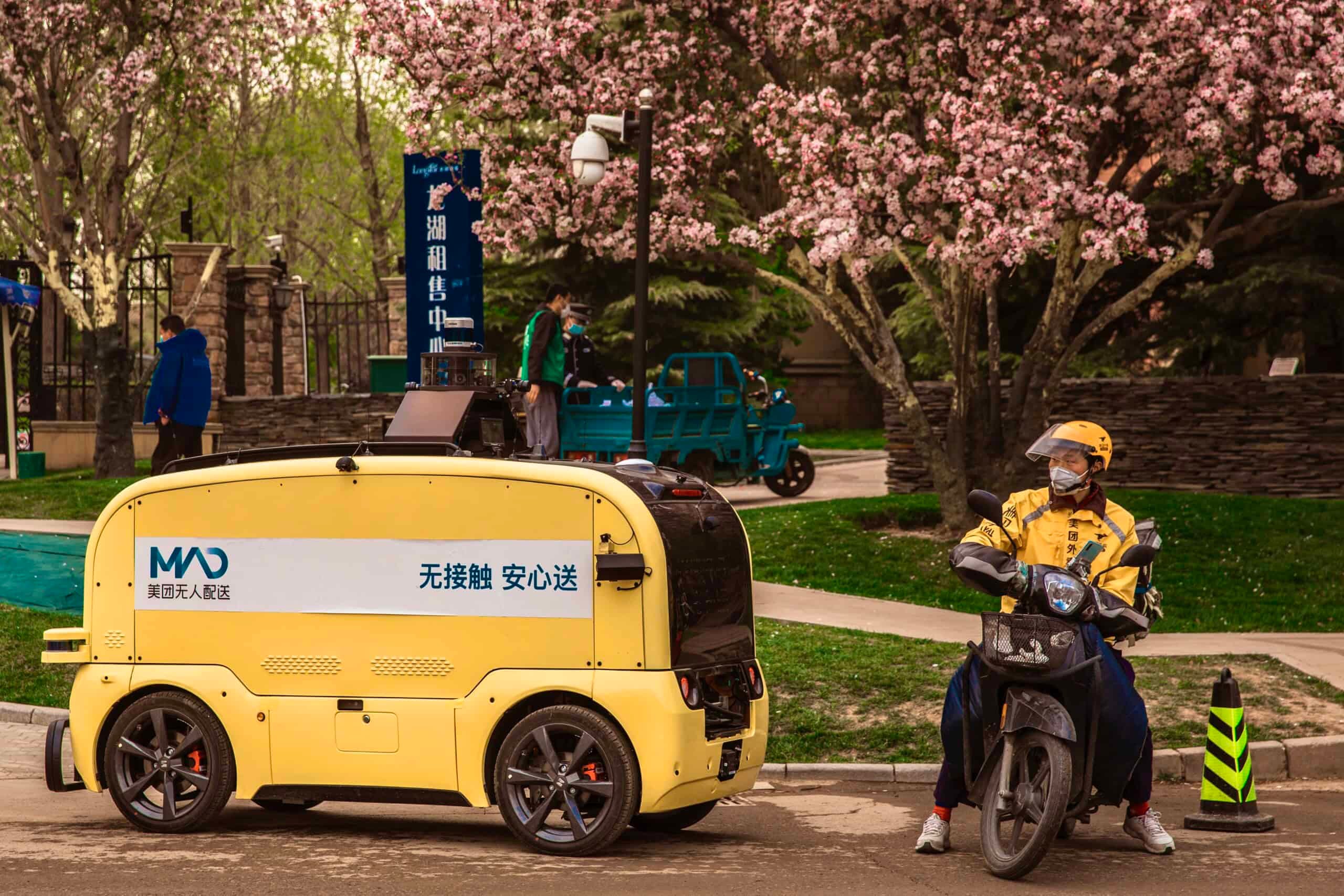
We see other parts of H3 establishing themselves, too. Bike and scooter share are ubiquitous in many cities. Cycling infrastructure has become much more common in both the US and Europe. In 2026, Waymo robotaxis operate in 10 US cities. In parts of China, robot delivery vans roam the streets.
Some examples of the three horizons in other areas…
Energy:
H1: Fossil-fuel grid, centralized power plants, gas cars.
H2: Utility-scale solar and wind, grid batteries, heat pumps.
H2-: natural gas peaker plants, carbon capture bolted onto gas, “clean coal”.
H2+: rooftop solar, using EV as a backup battery
H3: Distributed, bidirectional smartgrids. Homes and vehicles as storage. Community microgrids. Solar is cheap, so it makes sense to overbuild for cloudy days, which means energy overabundance on sunny days. The paradigm shifts away from conserving energy, toward finding useful ways to burn it off when the sun is shining.
What to watch: US and Europe are constrained by baseload and the sunk costs of fossil fuel investments. H3 is likely to arrive much faster in developing countries, where solar is competing against unreliable centralized grids, or against nothing at all.
Education:
H1: Industrial education, lectures, standardized tests, age-based cohorts, degrees as credentials.
H2: Laptops, online courses, AI tutorials added to existing schools
H2-: Lecture videos and automated testing software
H2+: Khan Academy
H3: Personal AI tutors. Self-paced. Game-like rankings with proof-of-work via projects instead of diplomas.
What to watch: The transformation of established education systems will likely take a very long time, since education sits in one of the lowest and slowest pace layers. Consider: Harvard University is older than the United States. However, we may see a faster pace of change within skills-based professions, and among home-schoolers.
Software:
H1: Humans write code by hand, teams scale by headcount. Tools: GitHub, IDEs, code review, tickets.
H2: Coding assistants inside the old workflow
H2-: Cursor-style autocomplete in the same old IDE.
H2+: Agents taking on whole tasks.
H3: Agents building, testing, and evolving software for other agents. Startups with no humans in the loop. An Internet of Agents.
What to watch: ransomware is probably going to be the first viable agent-only “business”.
So, all three horizons overlap and exist at the same time. This overlap happens because innovations diffuse according to a normal distribution, and different parts of the system evolve at different paces, and are at different points of the curve.
People also learn at different paces, and one way we can understand the s-curve is by seeing it as a learning curve, the learning curve of a society as its participants absorb a new idea.
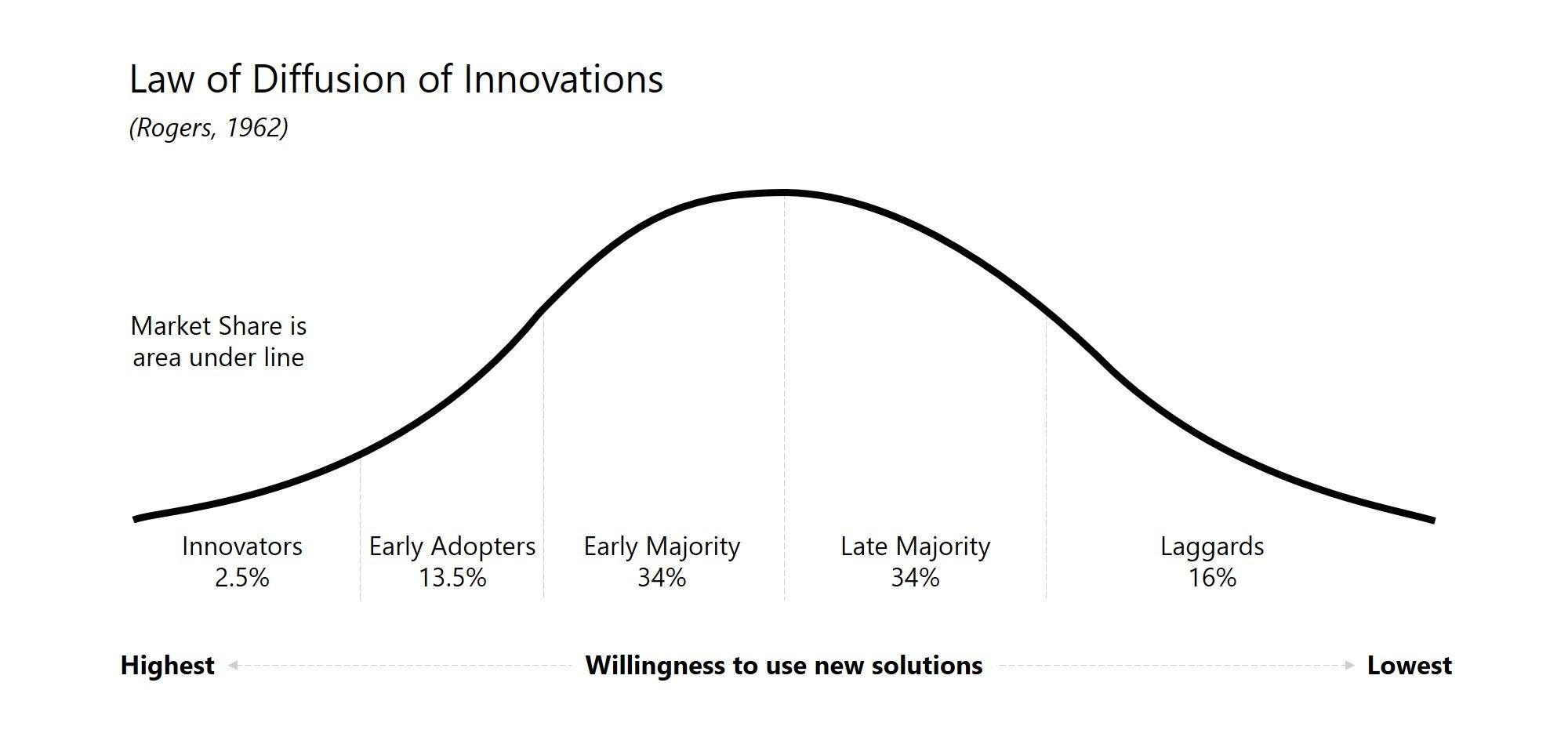
The three horizons emerge where we have two overlapping curves, an old one dying, a new one struggling to be born. In this context, three archetypes manifest:
H1: The Manager. Protects the status quo. Keeps the lights on.
H2: The Entrepreneur. Tries new things, sees what works.
H3: The Visionary. Evangelizes new aspirational values.
Futures are shaped by the push and pull between these archetypes. Managers think visionaries are quixotic. Visionaries think managers are dinosaurs. Entrepreneurs negotiate between these values and mark ideals to market, so managers see them as dangerous, and visionaries see them as sell-outs. It helps to know which archetype you play, and the archetypes of those you are negotiating with.
Technologies also have a say in this game. Some innovations tend to sustain existing incumbents. For example, established automakers have big advantages in the EV business. Disruptive innovations, on the other hand, Trojan-horse their way into a market by offering a worse-but-better solution to unconventional customers. Think electric scooters and delivery bots. Because technological improvement tends to outpace social change, you reach a tipping point where the old value chain is suddenly upended and the system is transformed all at once. We’re experiencing this with AI right now.
Questions I like to ask myself:
Which archetype am I playing right now? Manager? Entrepreneur? Visionary?
Who am I negotiating with? What archetype are they playing? Which archetype do I find to be the most frustrating?
What is the traffic jam? What knock-on-effects will this innovation have? How might it change our values?
Book: “Three Horizons: The Patterning of Hope”, by Bill Sharpe.