


I do not know.
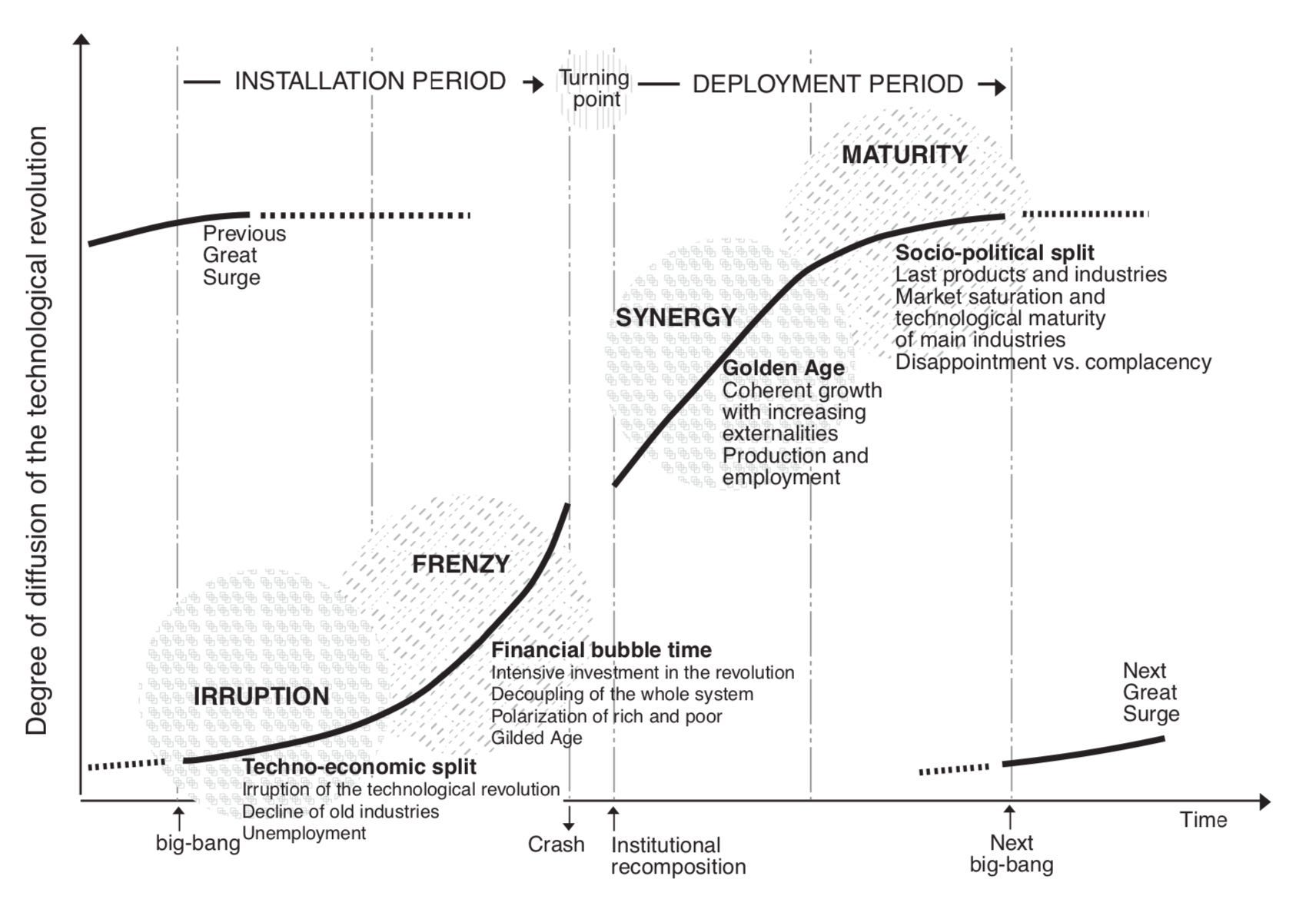
What I do know, following Clayton Christensen, is that we are in the beginning stages of a disruption. The signs point toward this disruption being bigger than the iPhone on the technological Richter scale. Another thing I know, following McLuhan, is that we are a network society, and networks do not produce nice normal distributions. They produce exponential booms and busts. I also know, following Carlota Perez, that AI is not just a technology, it is a technological revolution. The foom is real, but we will have to survive an epic bust.
What does it look like to have agency in this kind of VUCA environment? How to survive the disjunction? I’ve been puzzling over this, and have fallen back on a barbell strategy.
A barbell strategy is when you put most of your money into extremely safe assets, and invest a small portion in high-risk, high-reward bets. A common split is 90% treasury bills, cash, short-term bonds, and 10% options, venture bets, and volatile stocks. You avoid the middle entirely. This whole approach was pioneered by Nassim Taleb as a reaction to black swans, because in a black swan event, medium risk/medium return assets aren’t actually medium risk. They tend to lose big, while offering modest returns. That’s bounded upside, unbounded downside.

The barbell is designed to protect you from ruin, while exposing you to potentially massive returns. Bounded downside, unbounded upside.
Barbells are one of my favorite heuristics, along with double it or cut it in half, and chopping Gordian knots. My friend Ben Follington has another heuristic, how you do anything is how you do everything, and he says that barbells are how I do everything. This is true 90% of the time.
Whereas the migrant leaves behind a milieu that has become amorphous or hostile, the nomad is one who does not depart, does not want to depart, who clings to the smooth space left by the receding forest, where the steppe or the desert advances, and who invents nomadism as a response to this challenge… The nomads are there, on the land, wherever there forms a smooth space that gnaws, and tends to grow, in all directions. The nomads inhabit these places; they remain in them, and they themselves make them grow.
(Gilles Deleuze and Félix Guattari, “A Thousand Plateaus”)
Instead of being automated themselves—fragmented in task and function—as had been the tendency under mechanization, men in the electric age move increasingly to involvement in diverse jobs simultaneously, and to the work of learning, and to the programming of computers… Man the food-gatherer reappears incongruously as information-gatherer. In this role, electronic man is no less a nomad than his paleolithic ancestors.
(McLuhan, 1964, “Understanding Media”)
When going barbell, the first order of business is don’t die. There are several moves one can make to help stave off death, including cutting down personal burn rate, reducing exposure to personally catastrophic risk, and optimizing for flexibility.
The Instagram moodboard version of this is the Tech Yurt. A solar panel, battery, laptop, and Starlink make for a pretty viable nomadic stack.
Recurse Center, Mars College, and Edge Esmeralda offer turn-key versions of this high-tech/low-cost lifestyle. For me personally, cutting burn rate has been less glamorous, but after a couple of plot-twists, I have found myself outside of the US in a low-burn locale, where I am essentially default alive.
This software nomadism feels precarious, but then again, what isn’t precarious in 2026? I was chatting recently with a friend in big tech. He’s watching AI change by the week and is anxious about the opportunity cost of doing slide decks and middle management while everyone else is hacking. Exposure to upside is bounded (promotions), while exposure to risk is unbounded (layoffs and permanent job displacement). Many startups are also in a bind. As Steve Blank puts it, if your startup raised more than two years ago, it's probably DOA. Excluding a few AI companies like Anthropic, OpenAI, and Google, much of incumbent tech is looking like the kind of middle-risk investment that a barbell strategy tries to avoid.
Professionalism is environmental. Amateurism is anti-environmental. The professional tends to classify and to specialize, to accept uncritically the groundrules of the environment. The expert is the one who stays put. The amateur can afford to lose.
(Marshall McLuhan, “The Medium is the Massage”)
Freedom of movement, both intellectually and physically, is worth a premium in this environment. Ideally, you want to work on whatever is most important, with whoever is most interesting, wherever that needs to be. The goal of relinquishing attachments is not just to survive, but to gain this freedom of movement.
So, my move right now is to stay lean. A low burn-rate leaves me free to explore the jagged frontier full-time. I can follow my intuitions as a founder, and no one can tell me no.
For this to work, I need to budget for a fast internet connection and at least $200/mo in tokens. This is table stakes for gaining exposure to the unbounded upside. These costs are not nothing, but, speaking as an entrepreneur, it is far easier to get going from a standing start today than it was a few years ago, when you would have had to form a team and raise a round to start finding PMF. I’m also budgeting for conference travel, since the downside of living in a low-burn locale is missing out on the network effects of a city like San Francisco or New York. Conferences create condensed versions of this network effect. So, 90% building, 10% high-intensity networking. Another barbell.
After don’t die, my next priority is GLHF: Good Luck, Have Fun. In a greenfield, having fun maximizes your chances for good luck:
Another clue to the importance of novelty in innovation is that humans tend to be very sensitive to it. Often we feel the urge to explore a particular path or idea despite being unsure where it might lead. Our intuitions and hunches often prod us in directions that might not be justified objectively but still lead to something different or interesting. So it’s no coincidence that the concept of interestingness comes up naturally when discussing novelty. When an idea feels genuinely novel, that’s often enough to make us curious. The idea interests us even if its ultimate purpose is unclear.
(Kenneth Stanley, “Why Greatness Cannot Be Planned”)
Your novelty-seeking impulse is the compass evolution gave you to explore the unknown. Objectives often lead us astray in unknown territory, whereas finding and following the fun can help us discover potential exponentials.
To find the fun, we need beginner’s mind, to let go of preconceptions that were formed in the old environment. We need to take off the mask of the expert, and put on the mask of the hacker.
The Hacker - seeking surprise, steering by gut. The spontaneous disruptor demon who tinkers, breaks and modifies systems, discovers first principles, and unlocks new leverages along the way. The wizard, the pharmacist, the magician, the trickster.
(Ian Cheng, 2019, “Who worlds?”)
So, demos over memos. Build to think, and log what you learn. As in any new greenfield, nature favors fast-moving r-selectors.
Another way to maximize good luck is to make more bets with low cost and high upside. The lower the cost, the more bets you can make. My cofounder and I have been working to reduce the marginal cost of making bets by building AI tooling. This is sort of an engine-building game:
We’ve been working on a multi-agent factory that can generate high-quality prototypes while we sleep. Coding agents have already increased my velocity by about 3x. I expect agent factories will be another step-change (10x?).
We’ve also been building a Web-component-based generative UI toolkit, designed to help agents piece together high-quality interfaces.
All of our infra is set up for Continuous Deployment (CD). Every change is automatically tested and immediately released to production. We ship at the speed of git push.
Soon, most of those pushes will come from our agent factories. Agents writing code, testing code, shipping code. The goal here is to be able to riff on an idea, rapidly generate a prototype with an agent factory, test for PMF, repeat.
Two hackers, hundreds of agents, scale bounded only by the number of tokens we can usefully burn. This feels like the way forward, a new way to build a venture. Will it work? Let’s find out.
Good luck. Have fun. Don't die.